
8.1.2Which way do I slice?
The Disk Method
When slicing a solid such as a lime, the volume can be approximated by slicing the object into shapes that resemble cylinders, calculating the volume of each “cylindrical” slice, and then adding the volumes all together. However, to get a precise volume, the cylinders must become infinitesimally thin, and it is not practical to calculate the volume of each disk separately.
Consider the graph of
. In Figure A, a typical rectangle that can be used to calculate the area under the curve is shown. Describe the dimensions of the rectangle. 
.png)
.png)
When
is revolved about the -axis, the solid shown in Figure B is obtained. To calculate the volume of this solid, the volume of a typical slice is needed. Analyze the typical slice drawn in Figure C. Write an expression that will calculate the volume of this “typical” slice. The shape of each infinitesimally thin slice is called a cylindrical disk. Explain how a cylindrical disk is different from a circle. Then, explain how a cylindrical disk is similar to a cylinder.
Since the thickness of each disk approaches zero, you can use a definite integral to calculate the exact volume of the solid. Write an integral that will compute the volume of the solid on the interval
. Then evaluate your integral.
CALCULATING VOLUMES OF SOLIDS OF REVOLUTION
Since the beginning of this course, you have examined the volumes of figures formed when “flags”, such as
.png)
.png)
If this solid is sliced similarly to the solid in problem 8-12, describe the shape of each slice. What should you call its thickness?
Assume that the slice shown in the diagram above right is an arbitrary disk at some
-value, , between and . Write an expression for the volume of this disk where . Set up an integral that accumulates the volumes of infinitely small disks (with thickness ‘
’) as changes from to for the function in the diagram above.
Sketch the region in the first quadrant under the function
Imagine rotating this region about the
-axis. Sketch the solid of revolution and show a typical disk. A complete diagram includes labels and dimensions for the disk. Set up and evaluate the integral that calculates the volume of this solid.
Suppose the graph of the function in problem 8-13 is generated by the following piecewise-defined function. Set up two integrals that represent the volume of the solid revolved about the
Sketch the region in the first quadrant bounded by
Imagine rotating this region about the
-axis. Sketch the solid of revolution and show a typical disk. A complete diagram includes labels and dimensions for the disk. In your team, discuss how to find the radius of a typical disk. What should we call its thickness? Write an integral showing the accumulation of the slices. Use your graphing calculator to compute the volume of the solid.
Sketch a solid of revolution for the following regions about the given axes. For each, draw a typical disk. Draw an arrow showing the radius. Draw another arrow showing the direction of integration. Write the integral for the volume.
, , , ; about the -axis , , ; about the -axis


To celebrate their third year of business, the Goodslice Baking Company is creating a loaf of bread where each vertical slice will form an equilateral triangle. In addition, since they want to show how happy they are about their anniversary, they designed the base of the bread to be a circle. Given that the bread will lie flat on a table, draw a sketch of the new bread design. Homework Help ✎
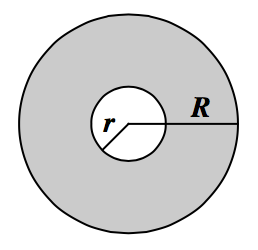
Write an expression for the area of the shaded region at right. The outside circle has radius
Multiple Choice: If
I and II only
I and III only
II and III only
I, II, and III
No two necessarily have the same value.
Multiple Choice: Which of the following expressions are antiderivatives of
I only
III only
I and II only
I and III only
II and III only
.png)
What is the radius of the largest disk?
What is the radius of the hole in the center?
What is the formula for the volume of the largest disk, in words?
Write an expression for the volume of each disk if
represents the number of times the radius is reduced? Use summation notation to write an expression that will calculate the volume of the weights Warren is lifting.
Calculate the total volume.


